DeltaN1 looks like a conversation. That's intentional. Conversations are how humans think out loud.
But the conversation isn't the product. The product is the lab behind it: always-on systems that watch your baselines, test hypotheses against your history, and keep retesting what they think they know as your life changes.
One idea: whatever problem, goal, or aspiration you bring, you should not have to become a researcher to find the truth. You should be able to talk normally and still get evidence, not guesses.
What the lab makes possible
Early warning (before you feel it)
A single low HRV day doesn't mean much. A pattern does. When several signals drift together—sleep, recovery, resting heart rate, energy mentions—the system can flag that something's off and draft a plan update before you have to ask.
Keystone discovery (one change, multiple downstream benefits)
Most apps stop at one-step correlations. The lab traces chains: A → B → C. Correlations become hypotheses; hypotheses become experiments. That's how you find keystones: the simple change that unlocks everything else.
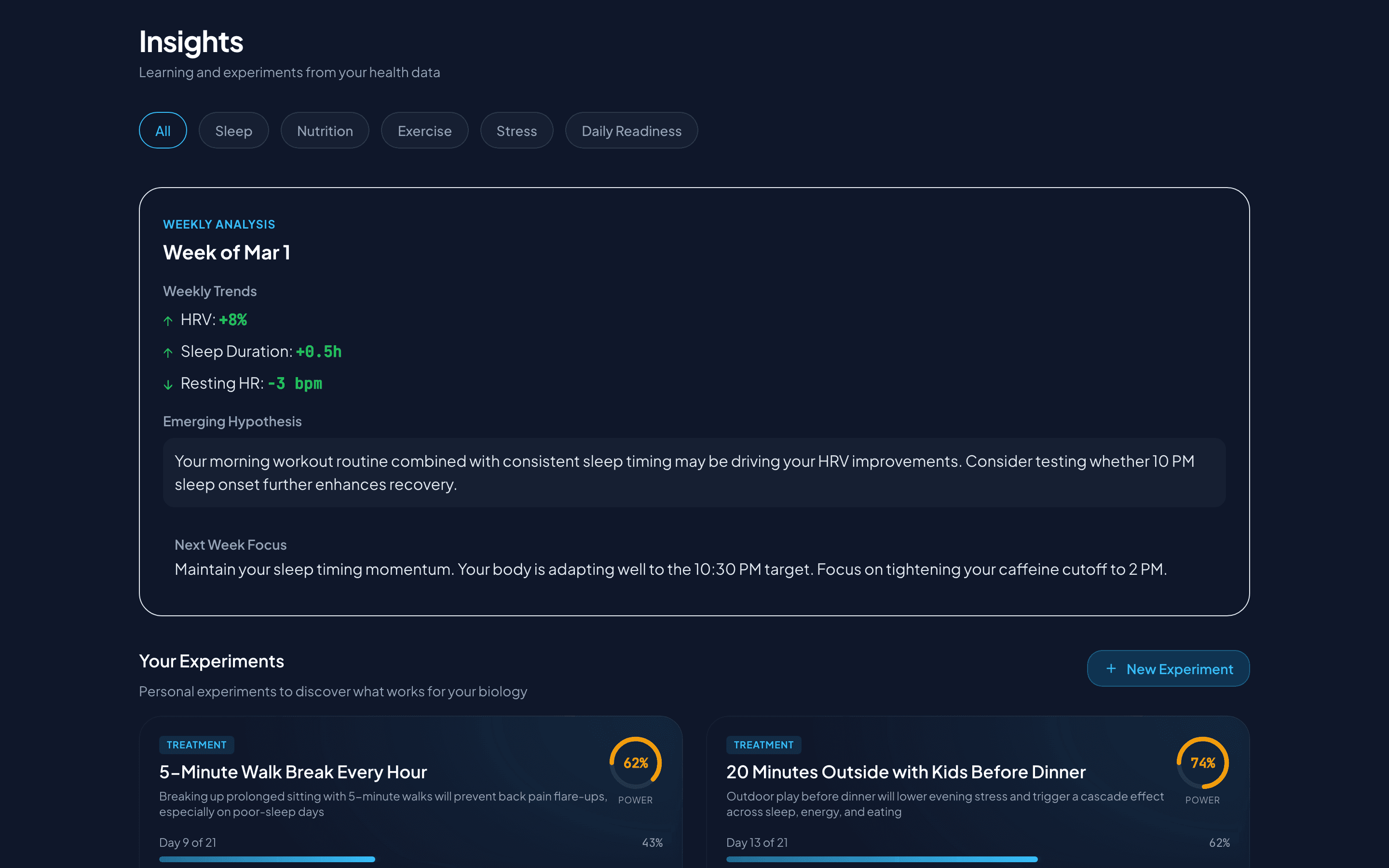
Proof loops (before → after, not "try this" forever)
After you try something, the lab follows up: what changed, what didn't, and what we learned. Validated results become defaults in your plan. Weak signals stay labeled as "worth watching."
Example (demo): "You tested eight supplements over 90 days. Six showed no detectable effect. Creatine — $12/month — was the only one with a validated impact on recovery. Supplement bill: $180 → $45."
Turn your beliefs into tests (bring your theory)
Think cold plunges help recovery? Think late dinners ruin your sleep? The lab can design a clean personal test with a timeline, measurable outcomes, and the minimum tracking needed to get an answer.
You: "My back pain is getting worse. Is this just aging?"
Lab: "Not aging. Your pain flares when you sit 4+ hours and slept poorly the night before. Either one alone is fine — it's the combination. Let's test 5-minute walk breaks every 90 minutes."
Track less over time ("good enough" is valid)
The point isn't endless logging. The lab tells you what's worth tracking to unlock signal—and when you can stop. When you've figured something out, you can mark it as good enough, and the system stops pushing while still watching quietly for drift.
Selfie science (passive signals you can't fake)
A weekly selfie can become a passive data stream: body composition trends, posture changes, skin and recovery indicators. It's not about perfection. It's about noticing changes over time when you're too busy to log.
How answers get better than "it might be…"
When you ask a typical tool why you feel off, it gives you plausible causes. That's not useless, but it's a hunch dressed up as an answer.
DeltaN1's lab does work before the conversation: running analyses, checking confidence, and keeping an evidence trail. Then the conversational layer translates the result into something human.
A panel, not a single voice
Some questions are nutrition questions. Some are sleep questions. Some are stress questions pretending to be fitness questions. DeltaN1 routes analysis through specialized experts—nutrition, exercise, sleep, stress, recovery, performance, environmental—and synthesizes a plan that fits your constraints.
Honest uncertainty
The point isn't to sound confident. The point is to be honest: when the system knows, it says so. When it doesn't, it tells you what would reduce uncertainty and which experiment is worth running next.
The quiet value (the stuff you don't notice until you need it)
- Drift + revalidation: when your baseline shifts, old truths don't linger as stale advice.
- Context integration: calendar, environment (AQI/pollen/weather), labs/docs, and device harmonization.
- Safety guardrails: fewer, safer, higher-conviction moves instead of endless suggestions.
- Tracking orchestration: short bursts to answer a question, then less tracking—never "log forever."
- "Good enough" mode: when you're satisfied, we stop proactively coaching that topic unless something changes.
ΔN1 is a wellness tool. It doesn't diagnose or treat disease. It helps you see patterns and test what works for your body.